Showing posts with label church militant. Show all posts

2009-11-20

Friday Lynx, 2009-11-20

Not much happening on the internet this week (hah!), so just a couple:
  • First, and most important: If you haven't heard about the Manhattan Declaration, you really ought to go check it out and seriously consider signing it.
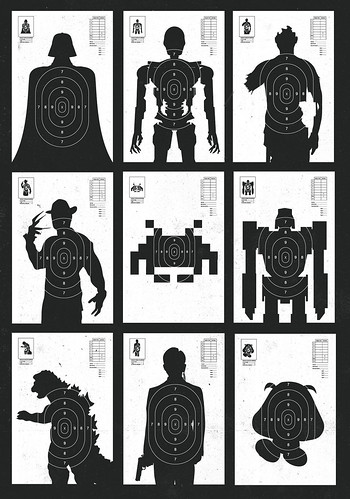
  • Secondly, something for my in-laws, you know, the gun-crazy ones:


Sorry, no YouTube video this week. More internanity next week. Enjoy your weekend!

2009-04-23

Why I'm not a pacifist

I was thinking of titling this 'Why pacifists are wrong', except that I don't know for sure that they're wrong, and I think that to some degree it is a 'personal' issue. But nonetheless, I'm going to tell you why pacifists are wrong. So there. [end caveat]

Being a student and instructor of the martial arts, and being a Christian who tries to in good conscience think about the relationship between my passions and Christianity (Christianity being not so much a passion for me as something I actually have to work at), I have spent what I consider to be my fair share of time percolating the relationship between peace, violence and Christianity.

Let me start be defining my terms:
Peace - am probably going to use the word 'peace' in two senses here: 1) Peace(1), the fruit of the Spirit which we are called as Christians to nurture and develop; 2) Peace(2), the state which life reverts to when it is cleansed of sin.
Violence - likewise, the word 'violence' will be in a couple of senses: 1) Violence(1) - 'external violence', which is any means by which one party attempts to impose its will apon another party against their consent; 2) Violence(2) - 'internal violence', that state that is the polar opposite of peace, the fruit of the Spirit.

The 'inspiration' for this essay began as an imaginary conversation in my head that I was having with a classmate - whose name I don't remember - from several years ago who mentioned during one of our discussion classes that he was a pacifist, and an extreme pacifist at that. I remember being appalled and somewhat disgusted when he stated that he would not step in to stop a man who was in the process of raping his wife (not a theoretical wife, mind, because he was actually married at the time), a fact of which she apparently was aware, and with which she was apparently okay.

This statement convinced me that the man had decided that it was better to allow the suffering of innocents than to commit physical violence(1), and tonight it caused me to pose a question to him (in my imagination): If a crime were commited, you were the sole witness, and you have the knowledge before hand that the decision of the jury hangs on your testimony, would you testify for the prosecution in court?

My reasoning behind this question lies thusly:

If you would refuse to give your testimony in court, you would seem to have a major failing in your development as a follower of Christ. Ignoring the afflictions of the innocent is fairly soundly condemned in the Old Testament (see, oh, any of the prophetic books), and seems to fly in the face of doing our Christian duty, both as citizens and as loving neighbors.

If, on the other hand, you replied in the affirmative, then it would seem that you are making a distinction which does not exist. While your body would not be an instrument of physical violence, nonetheless violence would be handed out to this person, and - because I asked the question this way - that violence would be inextricably tied to your action. Either economic violence: the person would be relieved of some of his money in the form of a fine; or else what I will dub 'environmental violence': the person would be forcibly removed from his home and relocated to a place that he would probably rather not be, a.k.a. prison. It is even possible (and indeed likely) that the person would be subjected to physical violence, either at the hands of other prison mates (prison being one of the many places I never ever want to visit) or at the hands of an executioner should the crime be deemed worthy.

So, here are my thoughts the use of violence(1) and it's roll in maintaining peace(2) and keeping the commandments of Christ:

First off, I would state that violence(1) is a tool. Whether it is physical violence, or verbal violence, or social violence, etc., it is something that is used to achieve an end, that end being to impose your will apon someone else. Sometimes, this is bad. Okay, perhaps even most of the time this is bad. But sometimes this is good and necessary. As a parent, I find it necessary to discipline my children in order to discourage certain behaviours and encourage other behaviors. Sometimes this takes the form of spankings, sometimes time-outs, sometimes they don't get to play with certain toys for the rest of the day. As a father, husband and concerned citizen, I have studied self defense with an eye to knowing what to do should I need to severely discourage someone from hurting my loved ones.

Secondly, I would say that violence(2) is often, but not always an excuse for violence(1). I have felt the blood pulsing in my veins when I have yelled at my kids to knock it off. I have felt the surge of adrenaline when muttering at stupid drivers under my breath.

Third, violence(1) and violence(2) are not mutually inclusive. Violence(2) is very helpful for implementing violence(1), in that our passions give us fuel to drive our actions.

Until Christ comes again, violence(1) will always be the means of steering the world toward peace(2). When the evil man inflicts his violent(1) will on the earth, the only response is violence(1), whether it is in the armies that march against his invading horde, or in the gentle rebuke that chastizes him for his abusive language.

It seems to me that most pacifists shun physical violence(1) in an effort to escape violence(2). However passiveness is not the answer to violence(2). Love, joy, peace, patience, kindness, goodness, faithfulness, gentleness and self control are the answer to violence(2).

Violence(1) that is done by a person who is in possession of those fruits can be done without violence(2). Even if the adrenaline is pumping, the blood is rushing, and the person is dizzy from the passion of the moment, after the moment of violence(1) is gone, the adrenaline wanes, the heartbeat slows, and the person can look at his actions and - for the most part - judge truly that what he has done was necessary and sufficient.

So that's why I have chosen to study physical violence, and why I have a hard time understanding the person who has chosen inaction over action. If I have time and energy later, I want to address some of the Christian 'problems' with violence, and tell you why I'm right and you misunderstood. I'm sure it will be very ecucational for you.

2008-05-02

Spiritual Fruit - Introduction

I first really became aware of the fuits of the spirit verse (Galatians 5:somethingorother) when I started doing karate. It was always one of those verses that you felt ashamed not to be able to chime in with whenever someone would start it, but it was a surprise when I started karate and it was our class motto, recited every class. It only took a couple of recitations to get it memorized, and it took not that long to realize why it is an appropriate mantra for a Christian martial arts program, but it has taken many years to slowly come to grips with the implications of the verse. So here are some introductory thoughts regarding the fruits of the Spirit, and I will be following up shortly with focused percolations* on the individual 'fruits'.

The active fruits


The first thing that occured to me eventually is the fact that all of these fruits appear on the surface to be emotions, or passions. It sounds like Paul is saying that the eventual outpouring of God after enough spiritual formation will be that you will feel the following way: loving, joyous, peaceful, patient, kind, good, faithful, gentle, and self controlled. While this may be true too - see C.S. Lewis on the effects of action of emotion - I do not believe it is actually what is being said.

If you look a little closer, you eventually see that these fruits are actually virtues, or 'lifestyles' to choose a psychobabylic term. They are actions, rather than passions**. That is, they are things in which you are the actor, and not the passive receiver. They are muscles that you must exercise in order to use them when you need them.

All things in moderation


Secondly, I am coming to realize that, as with all things in the Christian life, each of these fruits involves a balancing act. All of them have various facets, which, when put together, make up a virtue. But if you focus too much on on facet over the others, you begin to lose the virtuousness of the fruit. Just like with real fruit, you can over water or under water, over prune or under prune, etc. Most of the time, it is not obvious at first what these balancing acts involve. This is one of the areas I am hoping to explore a little more deeply with this series.

The martial connection


Because I am interested in the martial arts and how other things relate to them and vice versa, I will probably spend at least a few bytes on the connection between the Fruits of the Spirit and karate. These connections will - of course - be at least partially limited to my encounters with the martial arts, but most of the points should be fairly wide spread.

So stay tuned, because I'll be kicking it all off with a doozy:

Love


*I use the words 'percolations' rather than 'meditations' to reflect the method by which I usually achieve such insights (if I may call them such); that being that I do not actively reflect on them for long periods of time, but rather they will sit in my back brain where some magical part of my mind will process them over a long period of time, eventually producing (in some cases) enough coherent thoughts to put together some sort of statement. Thus, I find it to be more similar to the slow and steady process of a coffee drip resulting in the cafeinated beverage my wife enjoys so much - or perhaps the slow and amorphous steeping process of tea, a beverage which I myself actually enjoy - rather than to some sort of mental or spiritual scrutiny.

**I would not have truly understood what this meant if it were not for Dr. Dave H. and his discussion on what exactly we refer to when we talk about the Passion of Christ, so props to Dr. H.

2007-11-20

Martial Tuesday: One board at a time

Last week I talked about breaking and the commitment that goes into it, and the comparison between that and dealing with sin and temptation, and before I had even published the post I had more thoughts on the issue.

In my karate training it was a fairly short step from breaking a board to breaking a stack of boards, and then to doing several breaks in succession.

Breaking a stack of boards is basically the same thing as breaking a single board, except that it requires greater commitment. Instead of breaking through a barrier that is about an inch thick, you are breaking through a barrier that is 6 inches to a foot thick. Depending on how the stack is arrangedit may be exponentially harder to break or just geometrically harder to break, but the general idea is the same.

But a series of breaks is a different creature. A series of breaks is confusing because the idea is to break the whole series in rapid succession, so you have to plan the whole series out and keep them in mind. But you can't break all of the boards at the same time, and if your mind tries to, you will break none of the boards in rapid succession. You have to break it down and take it one break at a time.

Our sensei puts it like this: "It isn't five breaks. It is one break, five times."

It sounds very Zen, which is sort of on purpose. I mean, if you're going to be a karate instructor, part of the fun is getting to say Zen-ish with a fake Chinese accent. But like so many things, there is truth to it. If you let your mind think about everything you have to do in the next 10 seconds, you will not be able to commit it to the first board you break, and as I noted before that creates a destructive cycle and gives your mind yet another thing to think about while you are not-breaking the second board, and so on.

Instead, it helps to step back for a minute, and consider everything that is supposed to happen. Take in the flow of the break (in this case, 'break' referring to all of the individual breaks as a whole), and the flow of your body as you execute it. And then, let it go. To quote one of our instructors, "Mokuso, let it go." Once you know what needs to be done, forget about everything except what is in front of you now. And then explode through the break.

Once you have destroyed the first board, forget about it. It can't help you now, and you can't help it. Remember the second board and destroy it. Then forget about the second board, and repeat until there is nothing but splinters left.

To bring this post back around to what will eventually become its tired analogy, temptations won't always be weak things. Some great saint said that no one comes to understand the power of temptation who always gives in right away. That person cannot grasp the temptations that will come in time. They have not yet broken their first board, and so they cannot grasp breaking a stack of boards. As time goes by, our Sensei allows us opportunities to grow stronger by giving us bigger breaks.

And sometimes things will start to pile up. We'll find ourselves struggling with 5 different things at once, and it begins to get overwhelming. We need to stop and take a look at what is ahead of us, and then we need to forget about it and focus on one thing at a time. As Jesus said, don't worry about tomorrow. Today has enough things to worry about. He wasn't saying we shouldn't be prepared for the future to the degree that we can. But when trouble seems to be looming, prepare for it and then let it go. Sufficient to each break is the difficulty thereof.

2007-11-13

Martial Tuesday: Break through

Watching a martial artist break a board can range anywhere from the mundane to an expression of existential bliss. It all depends on who the person is, what his experience level is, how difficult the break is, and a number of other factors that will never be exactly the same, even if they appear so.

The experienced martial artist will probably approach the break with a reasonable amount of nonchalance, looking calm and relaxed, but focused at the same time. The fresh white belt will approach the break with some trepidation and distraction, worrying about failing and/or hurting himself.

The one will have technique and experience on his side: he knows how to hit the board, where to hit the board, what to do with each part of his body to make himself into the most efficient toothpick producer possible. The other will have technique and experience working against him: he has a only vague idea of where and how to hit the board, and a very clear idea that boards tend to hit back. The blackbelt will be aware that a board can hit back, but an unbroken board hits back much harder than a broken board.

The blackbelt might take a few seconds, or even up to a few minutes to consider the break, and then will hit it hard, driving his hand, foot, or whatever through the boards or bricks, leaving only a trail of destruction.

The whitebelt will ponder the break for a few seconds, but usually won't know enough to know what to ponder, and so will step up and - after a few practice swings - take a swing at the board. Sometimes it will break. Sometimes it won't. In most cases, the whitebelt who breaks will be more surprised than the whitebelt who doesn't.

I have never had a student who has not been able to break. I have had students who have failed to break a board, but that's not the same thing. Every student I've had has had the physical ability to break through a 10-inch white pine board. But I have seen many students - both mine and others' - who have not been able to let themselves break, and they all have the same problem: Commitment.

Now, I'm not trying to talk psycho-babble-bad-relationship-advice here. I'm not talking about 'fear of commitment' like you hear about in bad chick-flicks. I'm talking about a lack of commitment, the (usually vain) hope that the board will just break itself if you touch it, and you won't have to do any of the work. Very occasionally, it does, and that's when we realize that what we thought was a board was really more like two scraps of wood with a splinter connecting them. In most cases, breaking a board takes a lot more mental power than physical.

I have come to the conclusion that boards are like temptations. As we look at them, we know how much it hurts to hit one running and bounce off, to 'try' to break out of sin, only to get thrown back in. In many cases we don't know quite where to hit it to break through, how to flee temptation, how to break the pattern. We don't realize that if we just hit that brick with a little force and a lot of commitment, the crystaline structure will shatter, and we'll come through with a surprised look on our faces and very few scars to show for it.

And here's another happy thought: Any time you hit that first board, it hurts no matter what. Even if you break it, your hand goes numb for a few seconds, then it tingles, then it feels bruised, and then it goes away. And the next time you hit that board, it breaks more easily, and it doesn't hurt as much. And then, before you know it, you've moved from a 4-inch board to an 8-inch board, to a 12-inch board. Your body hardens itself each time you hit something with it, and your soul is the same way. Each time you break through a moment of weakness, your spiritual bones get stronger, and what used to be a soft, flabby hand becomes a hardened, muscled weapon of mass destruction. It's a redemptive cycle.

But there's a downside to it too: Every time you hit a board that doesn't break, it makes it harder to break the next one. Your hand doesn't get any weaker, and your bones don't become brittle, but your mind takes damage, what we would call in roleplaying 'Composure Stress': you become less certain of your ability to complete the break, and you start to lose your commitment, and so you hit the next board (or the same one) with less power. It becomes a destructive cycle, and usually it takes help getting your momentum back.

The good news is that in martial arts you should be able to trust your sensei not to put something in front of you that you can't break, and if he does you can always walk away.

The bad news is that in real life you can't always walk away from temptation, in fact usually walking away is giving in.

The good news is that we have a Sensei - One who came before us - who promised that He will never give us something we're not able to break.

So step up and give it a swing.